

What to do when you and your partner disagree about managing the kids
If you’ve ever felt stuck on what do you do when you and your partner disagrees about managing the kids- then this is a must read. Here are some tips to communicate constructively and argue less about resolving these issues.
First things first, this is one of the most common occurrences for parents. It is rare that two people, with two different personalities, raised different ways, are going to see parenting in the exact same way.
Let’s tackle what comes up and tips to communicate constructively and argue less about resolving these issues.
I believe expressing different opinions in front of children is a way to model an aspect of constructive communication in a hopefully, mature fashion. Fighting in front of the kids isn’t a great idea, fight when they are deeply asleep or you are out of the house.
Try to find a time when it is quiet, you are not exhausted, ha ha, the kids are not running around (put on the TV on a Sunday morning) and chat.
This is an opportunity to talk about something you want to deal with regarding the children’s behaviour. For example, if you want to discuss screen time, or chores around the house, or how to discipline any age child when they don’t listen to you, you need to express your opinion to one another and really listen to the other person.
💙 Enter the dialogue as a team, remember you both love your children and want the best for them. Even though you may feel strongly about how to handle the situation, trust me there is no clearly RIGHT way.
💙 Except it is wrong to use physical punishment, it just teaches children to be physically aggressive.
💙 Express your point of view and why you believe it will be effective in dealing with your child’s behaviour.
💙 Ask your partner what they think about what you are saying.
💙 Ask them also what their point of view is and why they think this will help accomplish what you both want to achieve in teaching your child how to behave.
💙 Remember you may not be right and that really considering their point of view may be very useful.
It is not important who is right or wrong!
What is important is working together and being open minded and willing to entertain your partners point of view. Remember you are both on the same team and I have rarely met a parent who doesn’t want the best for their child.
You can always agree to compromise and find a solution that is somewhere in the middle or you can toss a coin and try one way first for a little while and if it doesn’t work try it the other persons way. My daughter used to joke that they would let my son in law raise the first child his way and my daughter raise the second child her way and which ever kid came out better would raise number 3. Well they have both raised all three and so far it is working out okay. But trust me, each child has their struggles and they continue to evolve in their parenting styles and approaches.
Take parenting classes together, read parenting books and discuss without calling each other names or consult a therapist
Some children are particularly challenging and you may need some professional advice to deal with the needs of your child. If you are stressed by your own parents problems, any marital difficulties, sibling or financial problems, or work related issues it will be much more difficult to be calm, consistent and focused on your kids. Please address those issues yourself, with yourself or a professional because everyone will benefit if you are less stressed and feeling better.
Raising children is a tough job and only when they are older are you able to look back and acknowledge what worked and what you might do differently. Be kind to yourself. Try to stay in the here and now and savour the previous moments, even if they are fleeting. Don’t believe others when they tell you their kids are perfect or they seem to be when you see them. No one posts pics of hysterical kids and parents.
Keep sharing with friends, you are certainly not alone in your struggle. Read Feeling Better beat depression and improve relationships with Interpersonal Psychotherapy. www.feelingbetterthebook.com
Share your stories and your opinions with me. Would love to build a relationship with you.
Cindy Goodman Stulberg, D.C.S.,C.Psych.
Psychologist and Director
Institute for Interpersonal Psychotherapy

How to Teach Emotional Regulation, Sharing & Cooperation with Toddlers
Learn how to guide your toddler through the early stages of emotional regulation & teach them how to share & cooperate.
So as you may know, I recently did a huge purge on my kids' playspace at home. I ended up filling a huge garbage of broken toys & toys with missing pieces, and then another huge bag of toys to donate because my kids had grown out of them or we had duplicates.
There's something so satisfying about filling those garbage bags and getting them out of the house.
Buh Bye!
See you later alligator!
Every time I purge that toy room it always comes back to haunt me how much "stuff" the kids have and how little of it actually gets used. It's this constant cycle of....
they get something new,
play with it religiously for a few days (or even a few hours),
and then it gets chucked into corner and on to the next best thing....
If we're lucky that item will surface again down the road.
and repeat!
sound familiar?
so.... as I was going through this purge, I was hit with a dose of inspiration from my friends over at the Smart Cookie Club, who legit up-cycle old household items and create very basic, low tech educational toys.
Last week I chatted with them live in Behave it or NOT! and they shared some ways that they teach their students emotional regulation, sharing, & cooperation with these brilliant toys & activities they make.
[🚨 spoiler alert]- these girls take garbage and turn it into gold!
While I was chatting with them I had a serious💡moment. Sooooo you're telling me I can....
1. save money by not having to constantly buy my kiddies new toys
2. recycle house hold item to get more value for the money I originally spent on those items
3. reduce our household footprint
4. do all this while teaching my kids some of THE MOST IMPORTANT life skills they need!?
WHAAAAAT!?!?!?!? This is a serious #parentwin!
Get comfy and ready to be inspired. I don't want you to miss this. All I have to say is you.are.welcome!

Let me know what you are going to do with the info you gather from this video. I've already started picking through my recycling bin for some items to up cycle for my kids. I might even save it all for March Break and have them create these new toys and activities with me.
Anything to get them involved and make them feel empowered!
You've got this!
-Cori
p.s. If you have a toddler that LOVES a good power struggle and knows how to push your buttons. Then I want you to download my FREE cheat sheet with 7 simple strategies to get your child to listen to you. You can start using my strategies right away! Let this be the game changer for you!

Double-click to edit...

5 ways to make your child's play space functional
5 strategies for organizing a functional play space for your child!
Hello 2019! It's a new year, which is a great excuse to clean house and start off feeling fresh & organized. Every 4-6 months I purge my toy room to clean out all the shit that accumulates over time.
You know what I’m talking about…. those miss-matched pieces in toy sets, missing puzzle pieces, markers without lids, broken toys, dead batteries, ripped books, food crumbs in random corners, and the list goes on....
A few questions for you…
1. Do you feel like your kid's toys are taking over your home?
2. Do you constantly feel like you are forever cleaning up your child's toys?
3. Are you ready to walk from room to room without stepping on toys?
4. Are you ready to create a space that feels clutter free & functional for your child?
so how similar are we? I scored 4/4 here. You?
Play holds a very important role in a child’s growth & development. Children primarily learn through play in the early years. Play is a brilliant process that deserves attention and a ton of nurturing. I designated a room in my house for a structured play space so I can have a bit of control to help my children expand their imaginations, develop their creativity, and foster their social communication skills. In order for all of this to happen, it's my job to make sure this sacred environment is set up for success. It's my job to be proactive and provide them with structure so they can really dive in. Here are my top 5 strategies for setting up a successful & functional play space.
1. LESS IS MORE. We want our children to develop their imagination so… we have to give kids the opportunity to get creative with their toys and use them in different ways. If they have an abundance of toys you are likely to see them play with 1 toy for a few minutes, chuck it across the room and move onto the next. That will be put on repeat until it’s time wash up for dinner. If you have an abundance of toys, you can rotate them monthly and put some away in storage. It's amazing how a kid reacts when you stash a toy away for a bit then pull it out a month or two later. It's like gold. I also tend to do this around birthdays and holidays when they receive an overload of gifts. I put a bunch of them away and pull them out systematically when I feel they are ready for something new. The bonus here is when your child has to get creative and use their imagination with limited toys, we often see that attention span & focus stretch. It’s a win-win! Here are a few options for getting rid of toys; donate used toys to families or charities in need, hand them down to family or friends with younger kids, do a toy or book swap with a friend, or donate them to your child’s school.
2. FIND A HOME. Every toy, book, costume, crayon, & stuffed animal needs a home. Every item in the play space should have a designated spot where it goes when not in use. If the item is homeless get rid of it! (remember- less is more). This builds predictability for kids so they know where to find things when they need them and it also gives them a concrete spot to put things away when it comes time to tidy up. This allows you to teach your child how to “clean up” in a very structured way” I label all the toy bins and drawers in our playroom so both adults and kids know exactly where everything belongs. None of us have an excuse. There’s no doubt that some toys end up in their friends houses for an extended period of time, but at least when I do my 4-6 month purge, I can easily just drop it where it belongs.

3. GET HIGH! Not every single item needs to be at your child’s disposal. Put things out of reach. Use the height of your space. I like to use shelving that is out of my kids' reach so I have a spot to put toys that require adult supervision. For example, board games with little tiny pieces that I don't want going missing or ending up in my dog’s mouth- this pup eats EVERYTHING! I learned my lesson with Perler beads!!! I left the bucket of them on my kid’s A&C table and came in the room to find them allllllll over the place. They now reside in a lovely home on the highest possible shelf in my playroom. A great hack for this is to take an ikea unit (you know the one with the bins) and mount it high up on the wall out of your child’s reach
4. BAG IT. ZIpper-ed bags are my best friend! I love the mesh zip up bags from the good old dollar store. Bags that zip are amazing for toys with multiple pieces, such as puzzles. I hate when pieces go missing or end up in the bottom of a toy bin in another room of the house. It’s so important to keep sets together. What’s great about having things in bags is when we are heading out for a long drive or to a restaurant- I can easily grab one of the bags from our toys room and bring it along with us. I use zip bags from arts & crafts, puzzles, figurine sets (we’re all about super heros these days), & stickers

4. DEPOSITS. Deposit bins are key to maintaining an organized space. There are often times when toys make their way out of the playroom and into tiny spaces and crevices around the house. To help manage that mess, I've put "miscellaneous toy bins" in common spaces around the house so we can deposit the toys in them until I have time to put them away in their proper places in the playroom. This helps me get toys off the floor at the end of a long day without having to expend whatever brain power I have left.

So… if you are wondering where the hell to start, my suggestion is to get 2 big bags. 1 bag for toys you want to donate of or store out of sight and the other bag is for garbage. Don’t feel bad about throwing out broken toys or toys with partial pieces. Your child won’t care and probably won’t even realize. If for some reason they have some deep attachment to items you want to get rid of then let them hold on to it, until they are on to the next best thing. It’s probably best to tackle this when they aren’t around so you don’t have any interception :)
Let me know how it goes.
You’ve got this
-Cori

I’ve got one more thing for you to help you start off 2019 STRONG! Here’s my cheat sheet with some of my go-to strategies for getting your child to listen to you. You can start using these strategies right away! Give them a try and let me know how it goes!

My biggest 2018 accomplishment
2018 was a big year! I have so much to be grateful for, especially my biggest accomplishment this year! I still can’t believe I did it!
Happy 2019!!!

I want to take this opportunity to wish you and your family a very healthy and happy new year.
From my family to yours!!! 🎉🎉🎉
So... did you make it to midnight? I certainly DID NOT! I saw 11:45 on the clock and still can't believe I made it that late- lame?
maybe a bit? maybe not!
what does it matter anymore?
I just spent the last two weeks out of the city at my cottage unplugged with family & friends. What matters to me is.... spending quality time with those that matter, making memories, & watching my kids have the time of their lives.
As I reflect back on 2018, I have so much to be grateful for. I have my health, my family, & my friends.
My biggest accomplishment of 2018.......This past year, I made a HUGE move and left my clinical job after 12 years to pursue this amazing work full time. This was extremely hard for me to do. It took me 6 months to make the decision to do it and another 6 months to act on it. With a TON of support behind me, I have been able to create a business and job, which doesn't really feel like work to me! I've created more work/life/home balance which was big on my 2018 goal list. It's been an amazing transition and has me doing a happy dance every. single. day. 💃💃💃
I'm now able to work with amazing parents like you to help find more balance within the parenting role!
I get to help parents feel more relaxed with their children so they can enjoy their time with them!
I get to help parents feel more confident when it comes to disciplining, setting boundaries, & expectations!
I get to help parents understand why their kids have certain behaviours and how to exactly deal with them!
I get to help parents support their children in succeeding in school!
Most importantly, I get to help parents improve the quality of their relationship with their child so they can be the best possible parent. A win-win for both parent & child!
Do you have any parenting goals for 2019? I'd love to hear from you! Leave a comment and let me know what you'll be focusing on this year. My biggest one will be figuring out how to get more sleep. I'm a night owl and love my down time in the evening, but it definitely comes at a cost the next morning. Unfortunately, I lose my patience very quickly with my kiddies when I'm tired- totally avoidable and I'm really hoping to curb this in 2019. Wish me luck 😴
Cheers to a healthy 2019! You've got this!
Cori
p.s. If you are a parent of a picky eater and want solutions to help support nutrition & mealtimes in 2019, then I've got something really good for you! Starting January 16th I'll be hosting an online Parent Masterclass with Dietician Ahuva Magder Hershkop. We will be providing a ton of strategies to support your picky eater. There are still a few spots left & New Years pricing is in effect for 2 more days. Grab your seat here!

Dealing with challenging relationships over the holidays
Whether it is a holiday dinner, New Years gathering or vacation with family, you may need to deal with “challenging” relationships. The following tips are intended to make your interactions FEEL BETTER.
This time of year whether it is a holiday dinner, New years gathering or vacation with family, you may need to deal with “challenging” relationships. The following tips are intended to make your interactions FEEL BETTER.
1. Remember you are often attending an event to make someone else happy, your partner, mother, boss. Doing things you prefer not to do, for someone you care about, makes it easier to accept being with people you don’t want to be with. Feel good about the kindness you are showing.
You are also modelling this give and take behaviour for your children, particularly adolescents, who don’t want to go to “boring” aunt Mary’s house, where everybody asks him too many questions. It is an opportunity to demonstrate the give and take that goes on between people in any meaningful relationship.
2. Don’t expect there to be any change in the people who you feel are “challenging”. They are going to behave in the same annoying way they have always behaved. But if you go into those social situations hoping that they will miraculously change in the next ten days or two weeks you will be sorely disappointed. Expecting people to be exactly the same as they were last visit, will help you FEEL BETTER and be much less disappointed. You might even laugh at the first irritating comment.
3. Be prepared with answers to the typical annoying questions or comments that friends and relatives ask at social gatherings.
“When are you two having a baby?”
Answer with humour-don’t worry grandma you will be the first to know.
Or We prefer to keep that private, tell me what you enjoyed most about parenting?
“The children need to be taught better table manners”
The best answer ever for many comments is I am sorry you feel that way.
It acknowledges that you have heard the other person but doesn’t engage with them or create immediate conflict. Then deflect. I wanted to make sure I told you how well your grandson/daughter is doing at school. His teachers love him.
4. Pamper yourself before and after the social interactions. Buy yourself flowers, get a massage, buy the expensive bottle of wine you were reluctant to buy last week. Something to look forward to.
5. Find the least annoying person in the room and spend time with them. Notice the special positive moments that are occurring, the nice music, warm fire, decorations, and savour the moment.
6. If you want to address an issue with a friend or relative do it ahead of time. Start the conversation with a positive, “we really appreciate all the lovely gifts you give the kids”, express your issue clearly “we would appreciate you giving the kids fewer gifts this year, we want them to appreciate what they get and not have too much” and ask the other person what they think or feel, would that work for you? This can create a mutually respectful dialogue.
7. When some relationships become extremely difficult and you want to change the holiday/vacation plans you should do so. It is not your job to make everyone happy particularly at your own expense. Meet your own and your immediate family's needs and find different ways to spend time together with other friends and family. You have not done anything wrong by making a change and you can find effective ways to deal with the range of feelings you may experience.
For more strategies and tools for building good meaningful constructive relationships during the holidays and throughout the year check out. https://feelingbetterthebook.com
Feeling better beats depression and improves relationships with interpersonal psychotherapy

Cindy Goodman Stulberg, D.C.S.,C.Psych.
Psychologist and Director
Institute for Interpersonal Psychotherapy
Double-click to edit...

Teach gratitude NOT entitlement
Want to avoid raising an entitled child? Here are 3 effective strategies to try out over the holiday season!
I'm just coming off of a week long high from our all of our (what feels like 875,125) Hanukkah celebrations. I'm officially exhausted and ready for some downtime! Around this time of the year I always find myself having the exact same thoughts.
What do I want to teach my kids about the holidays?
Should I put a lot of emphasis on the religious stuff? (even though we aren't religious people)
The traditional stuff?
The cultural stuff?
ahhh!!!! What the heck is best for my child???
What I've observed so far is that a mix of the above variables have made it's way into our home over the holidays, and it's worked for us.
Now, aside from all the uncertainty around the religious, traditional, and cultural stuff that I should be introducing my children to, the one thought in my head that has been MOST consistent year to year is this idea around teaching gratitude. Aside from modelling this day to day, the holidays are a great opportunity to teach our children about gratitude. No, what makes this a little tricky is the idea around gifting & abundance.
How many toys does your child have that they NEVER EVER play with?
How much clutter does the abundance of toys in your house occupy?
Does your child play with a new toy for a few days and then completely forget about it?
When you try to get rid of toys does your child all of a sudden act like it's their most favourite toy EVER?
What the heck are we teaching our children by giving them an abundance of gifts all at once? or even grand gifts that are just over the top necessary. Does it become more about us than them?
Isn't your child more into the box or wrapping than the actual toy??
Now, Hannukah is 8 nights long and there are some families that choose to give their child a gift every. single. night. I personally think the idea is really cool but... in comes your child who is now expecting a gift every single night and starts to melt when the gift...
a. doesn't come fast enough
b. isn't as stimulating as the one from the previous night or
c. isn't what they expected it would be
At what point does the novelty run out? How can we teach the concept of appreciation & gratitude when there's such an abundance, and a set expectation. Truth is...It becomes really really hard. It actually backfires.
If your child has very excited and generous grandparents or family members & friends that all want to shower them with gifts for the holidays there's a few things you can do to avoid the abundance or grand gestures and really focus on what matters; appreciation & gratitude for what you have and what you get. In my books- it's always going to be quality over quantity!
1. Experiences over material items- if anyone of the gift givers are asking you for input, then recommend gifting an experience vs. a toy. This is a great way for children to be out in the world learning all types of skills and building memories. This year I bought my cousins' kids gift certificates to the movies. In the past I've also done tickets to the aquarium, zoo, science centre, & Canada's Wonderland. Now, this can be a win-win if the person gifting the experience wants to enjoy the experience with your child- they take your child out & you get a bit of a break! #momwin

2. Stash & Store - This is what my dining room table looked like after ONLY the first night of Hanukkah- 98% of this has now been stashed and stored away. This is my go-to around the holidays and birthdays. When my children get an abundance of stuff all at once, I literally hand them 1-2 new items and stash the remaining items away in storage. I now have a bank of new toys and activities that I can either pull out on a rainy day or use as a reward for exceptional behaviour. The point is, they come out very slowly over time.

3. Donate- If you know your child is receiving an abundance of toys and there's no way to avoid it, then build in a pay-it-forward system. Find local charities that take toy donations over the holidays. Have your child physically go with you and donate a toy to someone in need. To make this meaningful, discuss with them the importance about donating toys. You can go one step further and have them donate something they actually like or care about. Giving up something you care about is a very hard skill for a child- this is a great opportunity to strengthen that skill!
Moral of the story... Keep it simple for you child! Continue to find opportunities to teach them how to be a good person. This is a great time of the year to reflect on your parenting style and suit up for 2019. If you want support setting new parenting goals for 2019, then let's chat! Book in a FREE 30 minute call so we can get you equipped with tools to be the best parent you can be.
You've got this!
- Cori
p.s. I've got a super exciting announcement coming for 2019. I'll be announcing it first in Behave it or NOT! so make sure to keep your eyes open for it!

"heads up"- get your child to listen to you.
My most used strategy lately has been the "heads up" strategy. This is my 'go-to' when I need my kids to listen to me and transition away from something that they really really enjoy (cue a really deep breath).
I've been finding myself short fusing a bit lately and I'm not sure if it's because...
there are never EVER enough hours in a day to get shit done,
I'm not getting enough sleep,
I'm not carving out time for self-care,
or
ALL OF THE ABOVE!
(it's likely all of the above).
Now the shittiest thing about this is that my kids know exactly how to push every possible button of mine to get me to my breaking point. I wouldn't say it's intentional, they just both need my undivided attention at the exact. same. time. (funny how that works eh?!)
With that said, I've had to sit down and make a list of my most easiest (to implement) strategies that will keep me from reacting to them in a way that I'll regret the second after.
What's been my most used strategy lately has been the "heads up" strategy. This is my 'go-to' when I need my kids to transition away from something that they really really enjoy (cue a really deep breath).
Essentially when I know that a transition is coming up, I give my child a warning that what they are doing is ending soon and I let them know exactly what's coming up. For example; just last night my son way playing with his cars and I needed him to get in the shower. So I gave myself enough time to give him not 1, not 2, but 3 heads up that cars were ending and we would be having a shower. Third time's a charm! This is the rule here.
I use this strategy....
to get them in the shower,
to get them dressed,
to get them to the table to eat,
to get those shoes on in the morning,
and the list goes on......
This strategy is only effective if you give yourself enough time to give them the "heads up" that a transition is coming. So it requires a little planning on your part.
I feel such a huge relief when my children transition without putting up a fight. Best feeling!!!!! Total #momwin. It never gets old here.
Since we are dealing with little people here who have very little attention spans, keep in mind that a heads up warning is not effective after saying it once. Third time's a charm! I promise! I sometimes have them repeat it back to me each time just to make sure they are actively listening and not just hearing my noise.
Whether you are feeling exhausted, frustrated, or defeated- there's no reason you can't implement this strategy to help make things a bit easier for yourself. I want you to try this strategy out as soon as possible and let me know how it goes
You've got this!
-Cori
p.s. If you've already tried this strategy and have gotten push back from your child then we need to chat. There's a reason for that and I'll tell you why. Book in a free 30-minute call here.
p.p.s. If you haven't tried this out yet then go for it! I've got a full playbook of strategies and I'm happy to share them with you. I'm here to give you solutions so you can enjoy your time with your child and not have to feel anxious, stressed, or defeated. Book in a FREE 30 minute call so I can tell you how to gain access to my playbook!
Double-click to edit...

Parenting Epidemic 2018
WE HAVE A HUGE PARENTING EPIDEMIC on our hands…. so huge that we don’t even realize it in the moment. I’ll preface this with the fact that the way you spend time with your child is directly related to your child’s behaviour.
This summer my husband and I took a leap and pulled our kids out of daycare & camp for the month of August and spent the entire month together at our cottage. We figured why not do it while they are still young enough not to fight us on it.
We didn't know what to expect.
We didn’t know if we would last the entire month.
We didn’t know if the kids would be busy enough to keep them happy.
We didn’t know if the kids would be bored without other kids to play with all day every day.
We certainly didn’t anticipate it being as successful as it was!
Most people thought we were crazy for doing this because a month is a long time to keep your kids entertained and busy without going nutso. Many people questioned what the heck we were going to do with our kids for an entire month?!?

Well here we are! Survivors! We managed to slow down time and capture the most quality moments with our 2 children that we will never get back. We managed to shift away from work mode, and put that energy into time with our kids and each other. We both stopped moving and thinking so fast and adapted to our children’s paces. These were all choices we made. Choices that I’m forever grateful for. These are choices that I will continue to make on the days that I am home with my kids.
Why?
Because throughout the month of August…

My kids were happy. My kids were calm. My kids were relaxed. My kids were playful. My kids were compliant. My kids were kind. My kids slept well. My kids were healthy.
What more can a parent ask for?!?!?
…so what was so different in August from every other month of the year? no-doubt, there was a shift in quality, when we talk about our interactions with our children. For the most part, they had our undivided attention. We engaged in so many activities with them on a daily basis without the burden of our phones in our pockets or hands. We didn’t allow ourselves to get distracted by nonsense stuff that could wait until a later time. This was a true win-win situation for all of us.
If we look at this month away as a little social experiment then our results indicate that WE HAVE A HUGE PARENTING EPIDEMIC on our hands…. so huge that we don’t even realize it in the moment. I’ll preface this with the fact that the way you spend time with your child is directly related to your child’s behaviour. To keep it simple, if you keep your child’s attention bucket full then you will have a very happy child on your hands. If your child isn’t getting enough of your undivided attention on a consistent basis, then you will find yourself dealing with more defiant child.
I ask you this….
Do you spend time glancing at your emails when you are with your child?
Do you scroll through your social media platforms while your child plays at your side?
Do you multitask at home on your computer, while your child is hanging out watching tv in the same room?
If you answered yes to any of the above then please put down your cell phones and computers until your child is asleep. Your child needs your undivided attention.
Stop multitasking, stop checking your emails, and stop glancing at social media when you think they don't realize. They absorb everything about your non-verbal communication and behaviour.
I’m guilty here and didn’t realize the extent of it until August when I decided to shift gears during my children’s waking hours.
I challenge you to be more present with your child.
I challenge you to be more emotionally available for your child.
I challenge you to step outside of your comfort zone and feel silly when you play with your child.
Accept my challenge and I can guarantee you a very happy, relaxed and well behaved child.
Are you in?
-cori
p.s. if you accepted the challenge then I want to hear from you, let me know how it goes.
p.s.s. If you need strategies to help curb your own behaviour to make this happen then I want you to connect with me asap by booking in a free 30-minute consult right here! I’ll be posting lots of strategies around this in Behave it or NOT!
Double-click to edit...

Is it your parenting style or your child’s temperament?
What’s fuelling the power struggles in your house? Is it your personality and parenting style or your child’s temperament?
Is it your child’s temperament or your parenting style that fuels the power struggles in your house? Often when it comes to our child’s behaviour we become heavily focused on their actions, their feelings, their wants and needs. We question why they behave in certain ways and wonder if it will ever stop. How often do you stop to think about your own behaviour and how it affects them.
Sometimes?
Rarely?
Never?
Be honest here!
As parents, we are emotional beings that react with our gut. These natural tendencies of ours are linked to our personality and our personality heavily guides our parenting style. There’s no one parenting style that is better than the next but we do have to consider our personal weaknesses in parenting and make the choice to change our behaviour to better support our kids.
Let’s figure this out together...Which parenting style category do you fall into? You might fall into more than 1 category and that's completely fine. After you read this, your homework is to try out at least 2 of the strategies in the "try this" column and let me know how it goes.
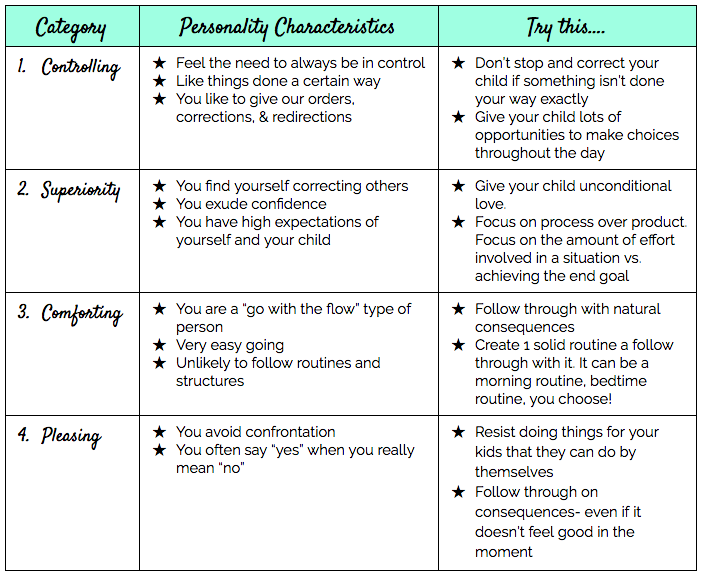
If you and your child often clash because you have similar personalities, then I want you to click here and book in a FREE 30 minute call so we can discuss more strategies for you to pull out of your back pocket. I want you to enjoy every waking moment you have with your child. There's not enough room in the day for frustration, anger, or feelings of defeat.
Double-click to edit...

10 ways to foster growth & development over the summer
Summer time is the best time for huge developmental leaps to happen. Children don’t make these leaps on their own. They count on you for a lot of it. Here are 10 ways to maximize your time over the summer to foster growth and development.
Summer is officially here! Yay!!! I find there’s a special relationship between the summer and a child’s growth and development. My own theory is that school is out, camp is in, and thus kids are overall more relaxed. A happy child is a relaxed child, and a relaxed child learns best. This also holds true for toddlers who aren’t in school yet. I find they spend A LOT more time outside, which means more time to move and groove. The more active the child, the more in balance they are internally and thus the more relaxed they are overall. The developmental leaps that take place over the summer are always the most obvious to me.
With that said, children don’t make these leaps on their own. They count on you for a lot of it. Here are 10 ways to maximize your time over the summer to foster growth and development.
Here it is…
1. Set up a solid structure & routine
Children thrive off of predictability. They do really well when they know what to expect and what’s coming next. So if your child is not in a full time daycare or camp program, make sure you are providing a solid structure throughout their days and weeks in the summer. Create a structure with very clear expectations and outcomes and create a summer routine that allows them to have lots of opportunity to experience new learning opportunities. If you can accomplish this, then your transition into the fall and start of school will be a breeze. This will also help keep disruptive behaviours down.
2. Provide your child with opportunity to contribute to your household
Toddlers & school-aged children need to feel a sense of empowerment to satisfy their developmental needs. They are now at a stage where they are becoming independent little people and learning how the exercise control over their world. The most functional way you can keep their empowerment bucket full is to start letting them contribute to household tasks. For example; making their bed, sorting laundry, putting their clothes in the laundry basket, preparing simple foods, turning lights on and off when you enter and exit a room, and the list goes on…. This won't happen over night, there's some teaching involved here but trust me... a little teaching now will help you out big time in the long run. Don’t forget to make this super FUN!
3. Lots of physical activity
Summer time is the best time to be outside and give your child lots opportunities to engage in proprioceptive and vestibular movement. These movements are necessary to awaken all the sense our bodies need to develop strong gross and fine motor skills. Let them climb ladders and slides, hang from monkey bars and problem solve their way through different playground structures. Bonus is that your child will build confidence and self-esteem from this!
4. Let them “do it myself” and “help”
The name of the game is INDEPENDENCE at this stage of development. This might be the most painful thing for some parents because we know there’s a dreaded mess that’s going to follow or just create more work for us but…. We have to see the value in process over product here. Children are convinced they are “response-able” at this stage and if we send them a message that we think otherwise then what are we really teaching them? Be patient, take a deep breath, and be ok with a little bit of mess.
5. Teach responsibility around peer and/or sibling interactions
Stop forcing your child to say “sorry”. What’s the point? What are you actually teaching them? You’ll be better off to help them label their own emotions when they are confronted with a conflict and help them work through those emotions. Empathize with them and let them know that you also experience these emotions. Once your child is calm then you can talk resolution with them. Ask them what they could do different next time. Ask them what they’ve learned from the situation. You might be shocked to see how inclined they are to apologize on their own or problem solve a little better next time. This does however take time and work, so don’t give up if it doesn’t resonate the first time around.
6. Model responsibility around caring for items
You are your child’s greatest role model in life! Be very explicit about choices you are making in and around the house. Start speaking your thoughts out loud. For example; “I forgot I left my shirt on the floor, I better pick it up and put it away” or “I’m feeling so tired but I better put my books away so I can find them tomorrow”. Model and they will do!
7. Teach your child a new skill every week!
This is the best! Create list of new skills you want your child to learn over the summer. Every week you are going to focus on one new skill and provide a ton of opportunity to practice that new skills. This is your time to get creative!!! If you have a child entering Kindergarten in the fall, this is the perfect opportunity to work on some of those essential skills they need for the Kindergarten transition- such as holding a crayon properly, using scissors, getting dressed by themselves, using buttons and zippers, opening and closing food containers, and the list goes on…. have fun with it!
8. Foster problem solving skills
The goal here is to present your child with new situations and activities and start asking them question to problem solve through them instead of telling them what to do. Encourage your child to explore different solutions and even ask questions if they are unsure. If you are binging on playground time while the weather is nice this is the perfect opportunity to foster problem solving skills. Take your child to new playgrounds and let them figure out how to navigate through the different play structures. If they get stuck, present them with questions to spark their thoughts. For example; “what can you grab on to to make it to the next level?”
9. Encourage risk taking
Be honest here… How many times a day do you say “be careful” to your child? We need to be cognizant of this and try to limit this expression. We need to expect bumps and bruises along the way. Taking risks presents our children with challenges. Working through challenges makes them feel so good!!! HELLO self-esteem! This will take them a lot further in their growth and development than constantly hearing “good job”, “ you did it”. Let them feel it intrinsically!
10. Do something a little extraordinary
It’s summer time!!! This is the time to do something new, novel, and extraordinary with your child. Give them an experience they’ve never had before. Whether it’s going to an amusement park, the theatre for the first time, a sleep-over, or blueberry picking (one of my personal favourites). These novel experiences are priceless learning opportunities for your child. Exposing them to something new will just help widen their view of the world and broaden their understanding of their own emotions, thoughts, and relationships with other people and things.
Double-click to edit...

The Kindergarten Transition
Starting Kindergarten is a huge transition. Your child’s success starts with you! It’s up to us parents to prepare our children for this huge transition and make sure they are feeling confident as they start this next chapter of their lives. Learn how to do this…
The K-Transition is a huge milestone for our little people. It marks the beginning of so much for them. It’s the beginning of their full-time school life, their academic career, a whole new sense of independence, and so much more. Children spend the majority of their waking hours in the school environment learning, exploring, socializing, growing, developing, and becoming meaningful members to society.
For some kids, Kindergarten will be the first time they are…
Out of the house for full days on a regular basis
Away from their parents &/or caregivers for full days
Not napping during the day anymore!
Learning & playing in a larger group of kids
Roaming the playground without an adult directly by their side all the time
This is a HUGE deal!
If you aren’t submerged in the world of education you might not know this but…. with the shift to full day kindergarten the expectations of our K-children have skyrocketed.
A few weeks ago I managed to find a whole hour to myself to go get my haircut. As I was sitting in the chair a friend of mine (who is a Speech & Language Pathologist and works in the school board) walked in and sat beside me. We got talking and despite us both being completely emotional that our daughters are transitioning into Kindergarten in September- we were discussing how it’s so tough for so many children to get through Kindergarten with such ease these days because of the expectations placed on them.
For example, they are expected to...
Be perfect little angels who can self regulate on their own throughout the day (all day, everyday)
Problem solve independently through conflict while playing with other kids (all day, everyday)
Organize, plan, and communicate their thoughts through play without conflict (all day, everyday)
And the list goes on….
Newsflash!!!! our little people haven’t necessarily fully developed the hardware to do all of this! The frontal lobe of their brain, which is responsible for a lot of this is still under big time development.
Knowing that this transition is a huge change for our kiddies and knowing that the expectations placed on them in the FDK curriculum are very high- how the hell can we prepare our children to be as successful as possible with this transition?!?!
Personally, I started my transition prep 4 months ago! I knew in my mind that I had to make this transition feel as normal as possible for my child so she can show up that first day, week, month feeling confident and comfortable. If you are reading this and you only have 3 months or so to go- don’t sweat it! You still have a good amount of time to prepare. Here’s a sample plan that I put together with a client of mine to get her child ready for the transition to kindergarten.
Keep in mind- these strategies were curated specifically for my client. Your child might be at a different phase in their development and that’s completely cool! The key to being successful with any of my strategies is repetition. This is how children learn!
Kindergarten Transition Plan

Regardless of what school your child will be attending for Kindergarten, a little bit of prep will go a looong way!! I promise you that one! If you are feeling overwhelmed and don't know where to start preparing your child then we NEED to chat. Book in a FREE 30-minute call so I can give you a starting point and some strategies to work with.
You've got this!
Cori
p.s. if you aren't already member... jump on over to Behave it or NOT! to join my online community where I'm always sharing lots of tips and strategies on child behaviour and learning.
Double-click to edit...

Let's talk MORNING ROUTINE!
A successful morning routine involves a little planning and a lot of patience. Whether you are an early-to-rise person or NOT you can be quite successful with a bit of strategy.
So if you are the "wake up before your child" type of person and you get your day started without any interruptions- then you should know I’m envious of you! The odd time I’m up before my children, I always have the exact same dialogue in my head...
"It’s so nice and quiet, I feel so relaxed, what a great way to start the day!"
The other 363 days of the year this is how it goes….
A typical morning usually consists of….
My children waking up and finding their way into my bed
The tv goes on and we have the most delicious snuggles (never want those to end).
After 15 minutes of watching tv and snuggling the race is on!
And in no particular order...
Get dressed!
Eat breakfast!
Get dressed again because clothing got dirty from breakfast
Brush teeth!
Shoes on! Jackets on!
Occupy the kids while you do all of the above
Oh ya… then one kids starts screaming because the other kid isn’t sharing toys
Then my daughter gives up and decides to change her clothes again because why not!?!? (does this stage ever end?!?!?)
The phone is dinging as those work emails start coming in on both mine and my husbands phones…
Then both my kids try to leave the house with toys in each hand to take to school (you know because there aren’t enough toys there already) and then comes the negotiation to get them to leave the toys at home…. cue the crying….
We finally take 1 step out the door and I realize I’ve left my phone inside- run back in and search everywhere for it.
WTF?!?!
Does this sounds familiar to you??
I recently did a poll in Behave it or NOT! and it looks like I’m with most you, which was a huge relief on my end so thank you for that!!!.

I’m certainly not an early to rise person, nor is my family. My children have become our alarm clock, and to be honest I’m totally ok with it. So what does this mean for us? …..our mornings are very face paced as we race the clock to get out of the house. Over the years I’ve had to figure out how to keep our house moving in forward motion --> to get out the door on time with minimal bumps along the way.
Efficiency is always my #1 goal.
I always get asked "how do you do it?"
Well here you go...Here are some of the strategies I’ve used to help us be successful with our morning routine.
- I always make a mental list (for those who know me, I love lists!!!) in my head of things I can do the night before to make the morning smoother. For example; pack bags for school, dance, baseball and throw it in the car- can’t forget it the next day if it’s already in the car! BOOM!
- Those first 15 minutes of snuggle time in the morning are a MUST- this is our opportunity to get emotionally connected with our children before the day gets started. All kids need a good dose of attention to fuel their day. Give it to them before your day starts so they don’t try to seek it out in a non-functional way while you are trying to rush out the door
- Minimize the number of transitions you require your child to get through from wake up to getting out the door. The way I’ve set up our morning routine is based on location in the house where tasks need to get done. So.. we start in our bedrooms (getting dressed, making bed) and then move our way to the kitchen (breakfast, wash up) which is close to the front door, and then front door for shoes & jackets and out the door! There’s very little back and forth required for transitions.
- If my child tries to swerve from the routine because she wants to "play with her toys"- I turn to the "when-then" routine. It would sounds something like this.. "When you get dressed and make your bed, then you can play with your toys for 10 minutes (timer is set for her)"
- Model a solid routine for your kids. If you are like me and aren’t one to get up before your kids, then go through the morning routine with them. You get dressed while they get dressed- getting dressed together is a great opportunity to connect and be in it together- kids love this!
- For children 3+ years old you can provide them with a checklist of tasks for them to follow in the morning. If they can’t read yet, use pictures. Kids love to be in control! What an easy way to give them a sense of empowerment to start their day! The only thing to remember here is this needs to be taught- go through the motions with your child a few times until you feel confident they can do it on their own.
In an ideal world, I would get up at least 30 minutes earlier than my kids to get myself dressed and ready for the day- This is on my "to-do" list.
-Cori
p.s. I love hand delivering strategies directly into your inbox. Sign up here for instant delivery!
Double-click to edit...

No punishment here.
Punishment is flawed. It has harmful short-term and long-term effects. It can back fire in the long run and create a lot of problems down the road. Don't do it! It's not worth it.
Is punishment effective? Is it necessary? Does it actually teach right from wrong? I'm not entirely sure about that but what I do know is that punishment creates a very uncomfortable physiological response in the child's body. With punishment comes blame, pain, and (or) shame, all which trigger the fight or flight response in children. This fight or flight response puts children in defence mode. Punishment also creates a spike in cortisol (a.k.a. the stress hormone) in the body. So are children actually learning what they did wrong or are they learning to avoid the physiological response they experienced from punishment? I would say the latter. Who the heck wants to feel shame? Who wants to experience physical or emotional pain? Not I, not you, not your child. There's a big difference between punishment and effective consequences. Punishment is a type of consequence but is very harsh, mean, condescending, and harmful. If used effectively, consequences can be more respectful, should be directly related to the behaviour, and have to be reasonable based on your child's age and stage of development. Punishment is flawed. Here's 5 reasons why...
- Punishment encourages children to lie. Once children experience the blame, shame, and pain from punishment they will what they can to avoid it from happening again.
- Punishment fosters resentment and anger. This is especially true for children who do not get enough 1:1 time with their parents. As well for children who don't get enough opportunities throughout their day to feel empowered.
- Punishment doesn't allow for teaching to happen. Children go into self-defence mode when punished. This closes off any opportunity to teach them right from wrong in the moment.
- Punishment weakens trust in the parent-child relationship. Trust is built on the foundations of love, support, encouragement, and safety. Punishment works against all of these.
- Punishment can encourage revenge behaviours. This is especially true for children who do not get enough opportunity to feel empowered throughout the day.
Parents often "punish" their child because in the moment they have a hard time regulating their own emotions. If you feel like you are getting heightened, take a deep breath or just walk away. Remember, every waking moment is a teachable moment. Take hold of each teaching opportunity to teach your children to be the best they can be. You got this!
- Cori

Avoiding Discouragement
A misbehaving child is often a discouraged child. Discouraged children love a good power struggle. Here are 6 powerful ways to avoid discouraging your child. Let's avoid those yucky power struggles!
When we talk about children's behaviour we know that it is goal oriented. We know all behaviours happen for a reason. There's no such thing as "it happened for no reason" or "it came out of nowhere". Our responses to our child's behaviour will always do one of two things. It will either strengthen the behaviour or weaken the behaviour. If we reinforce the behaviour we will see that behaviour over and over again. If we don't reinforce the behaviour we are likely to see less and less of that behaviour. Starting in the toddler phase of development, we start to experience the ever so famous "power struggle". These power struggles are inevitable, they are exhausting, and they take a toll on our day to day routines. The struggle is REAL! As a preface to all of this, we have to understand that our own behaviour has a direct consequence on our child's behaviour. Often without even realizing it, us parents do things that discourage our child, which often leads to triggering the power struggle. Misbehaved children are often discouraged children and discouraged children love the power struggle the MOST. So... this is good new for us. Wonder why? We have the ability to monitor our own behaviour to make sure we aren't inadvertently discouraging our children in this time of growth and development. You should NEVER mock, criticize, humiliate or use sarcasm with your child. These are very obvious ways that can lead to a discouraged child. We also might do things that are a little less obvious that can cause discouragement. Here are 6 powerful ways to avoid fostering a discouraged child; Try it out! Let me know how it goes! You got this!
DO NOT talk about them in front of them when it comes to misbehaviour or anything negative. This just gives a reaction and attention to the negative stuff. Broadcasting this information sends them the message that their behaviour is something worth talking about. Kids love attention (positive or negative)!
DO NOT do things for them when they can do on their own. This sends the message that we think they are incapable and have a lack of faith in their skills. This really pisses them off!
DO NOT expect perfection. Manage your own expectations- Practice doesn't make perfect, it makes permanent. The more a child practices a skill the deeper in goes into their memory. Don't expect adult like behaviour from them. They are kids!!!
DO NOT label your child. Do don't refer to them as the "shy one", the "crazy one", the "artistic one", the "loud one". This puts them under a lens and can be very embarrassing.
DO NOT compare your child to another child. Not to another one of your own children or another child in the community. This again comes from a place of judgement and can really hurt a child's self-esteem. Child who feel judged will often rebel and push back harder when it comes to the power struggle.
DO NOT overprotect your child. This sends them the message that they can't do things on their own. That they can't think for themselves or act for themselves. This very easily invites the power struggle. Let them have an opinion, make choices, and explore cause and effect variables in the environment (within reason).
Join me in my Facebook group Behave it or NOT! for a lot more practical strategies on managing child behaviour!
- Cori
Double-click to edit...

A Meaningful Mess
Here's what you need to know about effectively managing your child's play space. Enjoy!
I always love the feeling when I walk into my kids' playroom and it's spotless. Toys are put away in bins and drawers, random toy pieces have found their match, I can actually see the floor!! It's the best. BUT... what I love more is walking into the playroom and witnessing the process of that mess being made. This process is called playing and playing is learning. Kids have method to their madness, just like we do to ours. It's a brilliant process that deserves attention and a ton of nurturing. I use this space to help my kids expand their imagination, develop their creativity, and foster their social communication skills. In order for all of this to happen, it's my job to make sure this sacred environment is set up for success. It's my job to be proactive and provide them with structure so they can make the best mess possible. It's my job to make sure their mess is meaningful to them. Here are my top 5 strategies for setting up a successful play space.
1. FIND A HOME. Make sure every toy, book, costume, crayon, stuffed animal has a home. Every item in the play space should have a designated spot where it goes when not in use. This builds predictability for kids so they know where to find things when they need them and it also gives them a concrete spot to put things away when it comes time to tidy up. I label all the toy bins and drawers in our playroom so both adults and kids know exactly where everything belongs.
2. GET HIGH! Put things out of reach. Use the height of your space. I like to use shelving that is out of my kids' reach so I have a spot to put toys that require adult supervision. For example, board games with little tiny pieces that I don't want going missing or ending up in my son's mouth. The kid eats EVERYTHING!
3. BAG IT. Ziploc bags are my best friend! I've recently become a little more environmentally friendly and starting using mesh zip up bags from the good old dollar store. Bags that zip are amazing for toys with multiple pieces, such as puzzles. I hate when pieces go missing or end up in the bottom of a toy bin in another room of the house.
4. LESS IS MORE. If we are looking at developing those imaginative minds then give kids the opportunity to get creative with their toys and use them in different ways. If you have an abundance of toys, you can rotate them monthly and put some away in storage. It's amazing how a kid reacts when you stash a toy away for a bit then pull it out a month or two later. It's like gold. I also tend to do this around birthdays and holidays when they receive an overload of gifts. I put a bunch of them away and pull them out systematically when I feel they are ready for something new.
5. DEPOSITS. Deposit bins are key to maintaining an organized space. There are often times when toys make their way out of the playroom and into tiny spaces and crevices around the house. To help manage that mess, I've put "miscellaneous toy bins" in common spaces around the house so we can deposit the toys in them until I have time to put them away in their proper places in the playroom. This helps me get toys off the floor at the end of a long day without having to expend whatever brain power I have left.
Here's a glimpse into my kids' playroom. Some people ask why bother even cleaning it up if they are just going to jump in and make a mess again. We always have to reset the environment to provide a new canvas for them to create and learn from.

Double-click to edit...